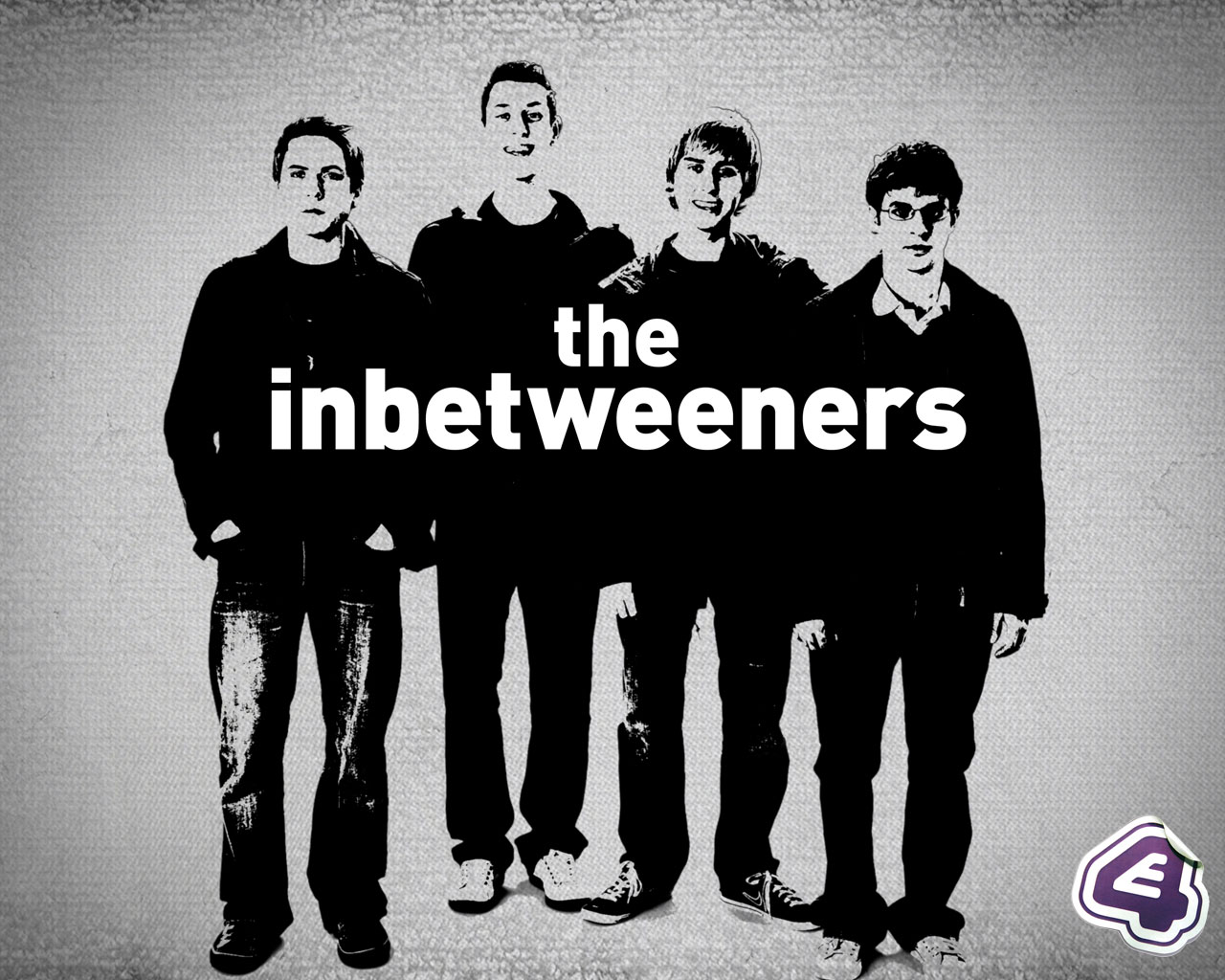
The bulk of the comedy of The Inbetweeners is 'cringe comedy', wherein a character (or characters) do something stupid and/or embarrassing things and they're caught out on it by others. For example, when Will is kicking and screaming about how three 'inconsiderate arseholes' jumped to the front of the line of a rollercoaster, only to find out that those three inconsiderates suffered from Downs Syndrome. That's one example of many scenes in which one of the four characters indulges in 'cringe comedy'. The name derives from the expression the viewer makes when witnessing such scenes.
The main reason that I can pin down as to why people watch The Inbetweeners is catharsis. Viewers can find comfort in this show as they can bask in the glory of not being this stupid. In life, you may feel worthless and insignificant, but hell, at least you're not this stupid. It sounds mean to say, but it really is true. These four characters, ranging from socially awkward to single-digit IQ recipients, indulge in the most stupid, narrow-minded, stereotypical acts, surpassing humour and reaching the point of catharsis. People may call it cheap comedy or stupid comedy, but it's stupid comedy made by smart people. It's made by people who understand the 'inbetweeners' of that age, and put those characters in situations they can't handle.
The 'inbetweeners' the title is referring to is the group of students that are too dumb to be 'nerds', and too pathetic to be 'cool kids'. They have no direction in life and aren't even enjoying the time in school that they should be. Even the smart one of the group, Will, fails his exams and becomes like them. With students of this age range, there is a lot of raunchy comedy on display. With Jay constantly lying about his sexual encounters (or lack thereof), Simon constantly chasing after the same girl (whom he throws up on her little brothers head), Neil who is constantly ridiculed about his father being 'gay' (whose sexuality remains undisclosed and ambiguous), and Will being too socially awkward to attract anyone of the opposite sex (but he does so anyway, ending disastrously). This inclusion of raunchy comedy strangely appeals to a younger demographic who enjoy sex jokes without understanding the real context of the joke. These 4 teenagers are completely pathetic, but someone immature might mistake them as being 'cool' because they talk about sex a lot.
I've watched every episode of The Inbetweeners (including the movie), and it mainly follows the same formula: one suggests doing something out of their comfort zone, they attempt it, they fail at it but try and act like they know what they're doing in effort to be 'cool', and they get themselves into trouble. To me, that's perfectly fine, as the four characters respond differently to different situations, and during the 20 minutes they have entertaining dialogue and opinions, distorted and uninformed as they may be. It might be offensive and often cruel, but it offers a realistic and relatable interpretation of the modern day, A-level burnout.
Thursday, 5 December 2013
Friday, 29 November 2013
'Hot Fuzz' extraction.
The narrative in this extract fits the action adventure genre mainly because of the main character and his actions. He only has 4 lines of dialogue in the whole extract, but Edgar Wright understands that actions define a character. Firstly, he rides on a white horse (or as Florence pointed out; a grey horse) through a conservative English town. White generally symbolizes purity and goodness, like the white dove from the Biblical Noah's Arc story. There's a low angle shot, emphasizing his dominance and presence over the local towns folk. He seems rather calm and relaxed for a man wielding dual machine guns into a village which he knows is hostile, specifically to him, but he remains stone-cold cool in a situation of almost certain death, chewing a toothpick as he passes by. He's positioned high, he acts suave and casual, all the while walking into a ticking time-bomb of a village. He's accurate and professional, almost as if 'pro' was the main tenant in a character termed 'protagonist'.
We can also identify with the pastiche used in Hot Fuzz. For instance, if you've watched any Western film ever, you can recognize the signature convention used in this extract. He strolls into town on his white horse, chewing a toothpick and wielding high-powered rifles, drawing the attention of all the townsfolk with the twangy guitars and harmonicas dwindling in the background. From this, we can instantly identify the action/adventure themes in this extract. We're familiar with Clint Eastwood and Django enough to know that any film imitating it is an action film.
Thursday, 21 November 2013
the IT crowd is alright.
I don't like canned laughter. At all. Woody Allen summed it up in Annie Hall.
Rob (To Alvy): We do the show live in front if an audience.
Alvy: Great, but nobody laughs 'cause your jokes aren't funny.
Rob: Yeah, well, that's why this machine is dynamite.
That sums it up for me. Canned laughter is a sign that you should be laughing, but you aren't. It's forced. A good comedy makes you laugh because it's funny, but a lazy comedy has to indicate when you should be laughing. It's what put me off Friends, it's what put me off Big Bang Theory (along with a bunch of other stuff I wont get into), and it was what initially put me off The IT Crowd. The bulk of the humour in The IT Crowd revolves around making fun of Chris O'Dowd's and Richard Ayoade's socially awkward, introverted man-children and all their cringy social encounters, and Katherine Parkinson's computer illiteracy and her incongruity in an IT department.
Richard Ayoade is always funny, but the actual jokes are often slapstick, much like 'good old-fashioned comedy', as in it's very obvious and heavy-handed lacking subtlety and wit. From I've seen, the plots twists and turns are dictated by how deep the introverts can dig themselves into the pit of social awkwardness, channelling the Mariana Trench, but it can sometimes be funny or at least mildly humorous. There is always potential comedy in three people who know little about social interactions indulging in social interactions.
As far as introverts go, there are a wide range of introverts that The IT Crowd depicts, unlike The Big Bang Theory which simply depicts all nerds and basement-dwelling troglodytes. There's the buttoned-up, 31-but-lives-with-his-mum stereotypically geeky type, the lazy, sloppy, poorly-dressed introvert with the work ethic of an overweights house-cat with no legs, and the obligatory woman character who has to be grouped with these nerds, but is no more introverted than them. She may be a Luddite, but is mainly independent who doesn't fall to gender conventions like many other Luddite-esque women. It's mostly obvious and silly, but it make me laugh quite a few times, so if it's intention was to make me laugh, then it succeeds as a comedy, I guess.
Richard Ayoade is always funny, but the actual jokes are often slapstick, much like 'good old-fashioned comedy', as in it's very obvious and heavy-handed lacking subtlety and wit. From I've seen, the plots twists and turns are dictated by how deep the introverts can dig themselves into the pit of social awkwardness, channelling the Mariana Trench, but it can sometimes be funny or at least mildly humorous. There is always potential comedy in three people who know little about social interactions indulging in social interactions.
As far as introverts go, there are a wide range of introverts that The IT Crowd depicts, unlike The Big Bang Theory which simply depicts all nerds and basement-dwelling troglodytes. There's the buttoned-up, 31-but-lives-with-his-mum stereotypically geeky type, the lazy, sloppy, poorly-dressed introvert with the work ethic of an overweights house-cat with no legs, and the obligatory woman character who has to be grouped with these nerds, but is no more introverted than them. She may be a Luddite, but is mainly independent who doesn't fall to gender conventions like many other Luddite-esque women. It's mostly obvious and silly, but it make me laugh quite a few times, so if it's intention was to make me laugh, then it succeeds as a comedy, I guess.
Saturday, 16 November 2013
fragrance advertisement analysis (final copy).
Unlike other adverts who make women seem defenseless and powerless yet pretty and seductive, an advert almost 100 years old can prove that you can make a feminine figure who also seems powerful and authoritative. She can appear this powerful figure whilst also keeping little touches of femininity, like the red lipstick.
She's positioned highly, dominating the entire image with her presence. She has her hair tied back, looking as if she is in control of herself and not loose or careless; she appears a taut woman. The colour red is a strong, vibrant colour, and is often used to emphasis a symbol of importance and/or power, see the Red Army, the Red Cross, the Chinese flag, and the main colour pallet for 1984. It's a powerful colour, and here it's used to empower the subject of the image: the woman. She's not flimsy or objectified, she has power and dominance. She's not just dominant over the image, she's dominant over herself. She doesn't succumb to societal pressure to be 'pretty' or 'hot', she's her own woman. She is independent. She has power.
I elaborated upon the idea that she is a powerful woman, but she is not an entirely masculine figure, as she still keeps touches of femininity, like her lipstick. This shows that a woman can be powerful and headstrong, but she can also be a woman, as power isn't synonymous with masculinity either. This is breaking the historical societal code that 'Men are men and women are women', in which men are the laborers, the founders and the pioneers, and women were merely an object to them, like a trophy or an achievement. This shows that a woman can possess all of the aforementioned traits, yet still be beautiful and seductive and all the other traits of the average woman. Yes, it is possible to be both, yet most advertisement, film and video games think combining these two characteristics is impossible.
The use of contrasting colours in important. There's contrast in the colours in the crown behind her head (black and white), but there's also the duality in the colours on her face. It could symbolise the contradiction in her character; she possesses traditional female qualities (the red lipstick and the plucked eyebrows) whilst being the aforementioned powerful figure. The colours and shades are sharp and precise, which could mirror the characters mannerisms.
She's positioned highly, dominating the entire image with her presence. She has her hair tied back, looking as if she is in control of herself and not loose or careless; she appears a taut woman. The colour red is a strong, vibrant colour, and is often used to emphasis a symbol of importance and/or power, see the Red Army, the Red Cross, the Chinese flag, and the main colour pallet for 1984. It's a powerful colour, and here it's used to empower the subject of the image: the woman. She's not flimsy or objectified, she has power and dominance. She's not just dominant over the image, she's dominant over herself. She doesn't succumb to societal pressure to be 'pretty' or 'hot', she's her own woman. She is independent. She has power.
I elaborated upon the idea that she is a powerful woman, but she is not an entirely masculine figure, as she still keeps touches of femininity, like her lipstick. This shows that a woman can be powerful and headstrong, but she can also be a woman, as power isn't synonymous with masculinity either. This is breaking the historical societal code that 'Men are men and women are women', in which men are the laborers, the founders and the pioneers, and women were merely an object to them, like a trophy or an achievement. This shows that a woman can possess all of the aforementioned traits, yet still be beautiful and seductive and all the other traits of the average woman. Yes, it is possible to be both, yet most advertisement, film and video games think combining these two characteristics is impossible.
The use of contrasting colours in important. There's contrast in the colours in the crown behind her head (black and white), but there's also the duality in the colours on her face. It could symbolise the contradiction in her character; she possesses traditional female qualities (the red lipstick and the plucked eyebrows) whilst being the aforementioned powerful figure. The colours and shades are sharp and precise, which could mirror the characters mannerisms.
Wednesday, 6 November 2013
final choices.
Points:
- Empowerment
- Minimalism
- Colours
- Cultural relevance
- Messages
The message of this 50's advert is that a man, no matter his physical appearance, will get the woman he wants and the treatment he wants. He's a large and hairy man, yet gets a conventionally attractive woman massaging his back, with the obvious help of this perfume. The man is represented
- Sexuality
- Messages
- Objectification
- Target Audience
- Historical Resonance
- Originality
- Relatability
- Famous actress appearing down to earth
- Comparison to other adverts
- Messages
Thursday, 17 October 2013
Tuesday, 15 October 2013
fragrance advertisement analysis (early draft).
The 'Vega' advertisement is from the 20's, but by then, Guerlain have already been around for almost one hundred years, so I guess you could say that Guerlain have had some experience in the field of perfume advertising. There were a multitude of advertisements I could have chose from the 20's, but I chose the minimalistic one because of how different it is. Firstly, in the 20's, photography was becoming more mainstream. Ad agency's wanted to have the best technology in their advert's to seem progressive and fresh. Guerlain were either ignorant of recent innovations, or this was intentional. They made a simplistic and minimal poster with a mere six colours. Guerlain proved that they don't need fancy new technology to make a powerful advert, as they're skilled enough to do so with a bare-bones simple design. Unlike the other perfume adverts I saw that demean and objectify women, this empowers women. This shows a woman with a spiky chess piece behind her head, empowering her as an authoritative and threatening figure. You can see that she's the higher figure in this poster; that she is above all. She's not objectified or demeaned by anyone; she looks like she's the type of woman that could run a business, or a state, not the type of woman that gets drunk at parties and sells herself. 'But Guerlain' they shriek, 'how can I be like this powerful and competent-looking woman?' Simple. Buy their perfume. That's obviously what they're selling, because you have to sell something in this industry, so why not sell something positive and less demeaning?
After feeling positive about the advertising industry for a short moment, let's move on to Centaur, a surprisingly sexualised image for the 1950's. I thought the 50's was a relatively conservative decade, and the liberalism emerged a decade later, but this advert is making me feel differently about that time period. Of course, it was a sexist time, so the rampant sexualisation of women wasn't uncommon, as displayed here. Of course, retro and nostalgia sells, as proven with most Indie Games and period dramas like Mad Men or Downton Abbey or Boardwalk Empire, but Centaur is taking retro to its logical conclusion. Instead of basing the advert 50 or so years into the past, it goes Ancient Greek. I've noticed that perfume adverts feed off needs like desire and lust. This one, for example, depicts an old man who probably wouldn't have been a ladies man, using Centaur, and then becoming a ladies man. This shows that if you use Centaur, you will become attractive and desirable with no real effort. It's slightly depressing how our society wants everything the easy way. For instance, 'The secret how to lose weight fast!' or some other demeaning untruth for the shallow. In this case, the advert is selling the idea of having beautiful women for the price of a perfume bottle. Anyway, Centaur is actually a Greek Mythological creature that is half man, half horse, or put simply, 'Half man, half animal'. The name of the perfume is subtly alluding that it's okay to let your animal side go.
Contrary to popular belief, women aren't the only group of people marginalized and stereotyped. What could be more obvious than a man's clenched fist as a fragrance bottle to sell masculinity and male pride/superiority? It uses typically male colours, black and blue (slang for the bruising of a persons flesh) and uses a block capital, bold and rugged font as its title. It's the most male-power fragrance I've seen in a while. A clenched fist represents a fighters fist, almost explicitly saying that this cologne will strengthen you. If you buy this cologne, you will become one of 'the brave', further selling exclusivity and desire.
The 'Vega' advert is almost 100 years old, yet little has changed. These three fragrance adverts all sell similar desires, whether it be power, ownership, masculinity, and yet a sense of falseness. Of course spraying cologne on your clothes wont make you stronger, of course spraying perfume wont make you powerful, but they want you to think that it does.
After feeling positive about the advertising industry for a short moment, let's move on to Centaur, a surprisingly sexualised image for the 1950's. I thought the 50's was a relatively conservative decade, and the liberalism emerged a decade later, but this advert is making me feel differently about that time period. Of course, it was a sexist time, so the rampant sexualisation of women wasn't uncommon, as displayed here. Of course, retro and nostalgia sells, as proven with most Indie Games and period dramas like Mad Men or Downton Abbey or Boardwalk Empire, but Centaur is taking retro to its logical conclusion. Instead of basing the advert 50 or so years into the past, it goes Ancient Greek. I've noticed that perfume adverts feed off needs like desire and lust. This one, for example, depicts an old man who probably wouldn't have been a ladies man, using Centaur, and then becoming a ladies man. This shows that if you use Centaur, you will become attractive and desirable with no real effort. It's slightly depressing how our society wants everything the easy way. For instance, 'The secret how to lose weight fast!' or some other demeaning untruth for the shallow. In this case, the advert is selling the idea of having beautiful women for the price of a perfume bottle. Anyway, Centaur is actually a Greek Mythological creature that is half man, half horse, or put simply, 'Half man, half animal'. The name of the perfume is subtly alluding that it's okay to let your animal side go.Contrary to popular belief, women aren't the only group of people marginalized and stereotyped. What could be more obvious than a man's clenched fist as a fragrance bottle to sell masculinity and male pride/superiority? It uses typically male colours, black and blue (slang for the bruising of a persons flesh) and uses a block capital, bold and rugged font as its title. It's the most male-power fragrance I've seen in a while. A clenched fist represents a fighters fist, almost explicitly saying that this cologne will strengthen you. If you buy this cologne, you will become one of 'the brave', further selling exclusivity and desire.
The 'Vega' advert is almost 100 years old, yet little has changed. These three fragrance adverts all sell similar desires, whether it be power, ownership, masculinity, and yet a sense of falseness. Of course spraying cologne on your clothes wont make you stronger, of course spraying perfume wont make you powerful, but they want you to think that it does.
Subscribe to:
Posts (Atom)

